Piazza San Marco around the Basilica
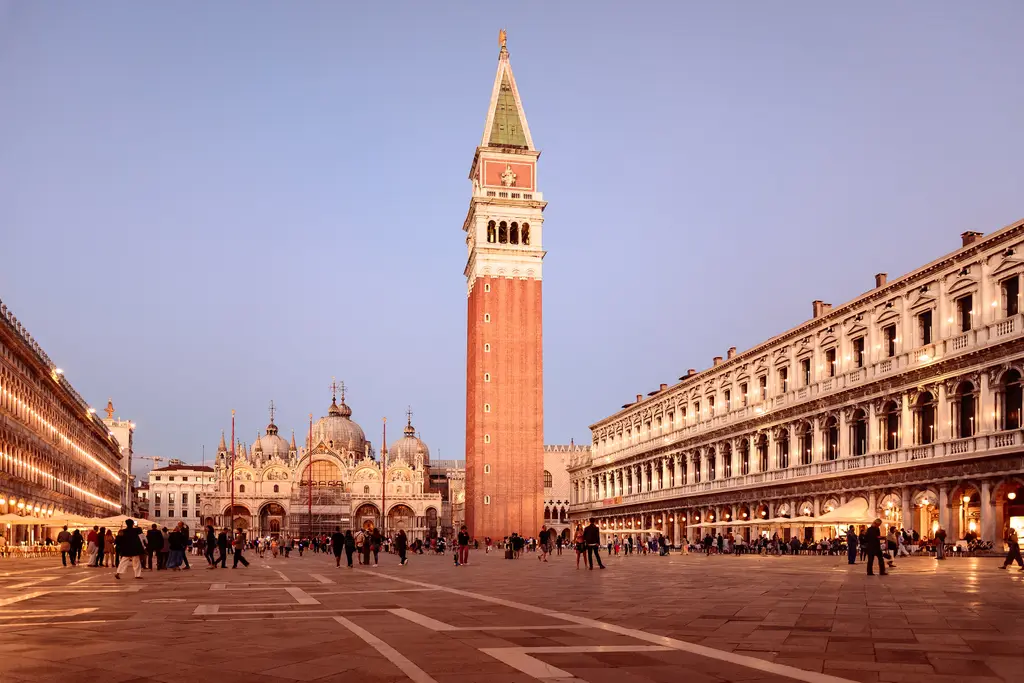
St Mark’s is one side of a square that was the political and religious heart of the Republic. Around it stand the Campanile, the Doge’s Palace, the Clock Tower and the Procuratie with the Museo Correr. They are separate visits, run by two different bodies, with separate tickets. Here is what each one is, and how they fit into one day.
One square, two operators
- The Basilica and the Campanile belong to the Procuratoria di San Marco, which sells their tickets on its own shop. Entry to the church is €10.00; the bell tower is €15.00.
- The Doge’s Palace, the Museo Correr and the Clock Tower belong to the Fondazione Musei Civici di Venezia (MUVE), with their own tickets and hours on their own websites.
The Basilica’s tariff lists no ticket that covers both. Since 1 July 2025 every ticket that includes the Basilica also opens more than thirty other Venetian churches and sites within six months of purchase, and the Casa di The Human Safety Net in the Procuratie.
The Campanile
The bell tower faces the Basilica across the square: 98.6 metres, collapsed in 1902 and rebuilt “as it was, where it was”, with a lift to the bells. It is open long after the church closes. See the Campanile.
The Doge’s Palace
The Basilica was the Doge’s chapel, and its south transept was joined to his palace by passages and windows (the architecture page). According to the civic museums, the palace’s origins go back to the ninth century; in the twelfth Doge Sebastiano Ziani replaced an older fortified structure with a building open to the city, with one wing for the courts facing the Piazzetta and one for government facing the basin. The lagoon side was renewed in the fourteenth century and the Piazzetta wing in the fifteenth under Doge Francesco Foscari; after a fire in 1483 the palace was rebuilt in the new Renaissance manner. In the seventeenth century the New Prisons were built and joined to it by the Bridge of Sighs. The last Doge, Ludovico Manin, abdicated in 1797; the palace has been a public museum since 1923.
What visitors report, in reviews from 2025 and 2026: the Bridge of Sighs is crossed from inside, as part of the palace route with the prisons, so you see it from within rather than from outside; and the palace takes anywhere from about an hour to three hours, depending on your pace, or around three hours for the Basilica, the palace and the Correr together.
The Clock Tower
On the north side of the square, over the street into the Merceria, stands the Torre dell’Orologio. The Senate commissioned the clock in 1493 from Zuan Carlo da Reggio; the clock was unveiled on 1 February 1499. The civic museums identify Mauro Codussi as the likely designer of the tower. On top, two bronze figures, the Mori — named for the dark patina of the metal — were cast by Ambrogio delle Ancore in 1497 and strike the hours, turning at the waist.
The Procuratie and the Museo Correr
The long arcaded buildings around the square are the Procuratie. The Museo Correr occupies the Napoleonic Wing and part of the Procuratie Nuove; its collection began with Teodoro Correr (1750–1830), a Venetian collector who left his works and his palazzo to the city.
The square itself
The Piazza is a made place. When Doge Ziani built a terrace across the Basilica’s front in 1177, it looked onto a new square created by covering over the Rio Batario, the Basilica writes. Beside the north front is the small Piazzetta dei Leoncini, with the Porta dei Fiori used for Mass, and the Ateneo San Basso. In front of the Basilica, a glass barrier now protects it from high tides (acqua alta).
A day on the square
Our suggestion, not an official one:
- Morning: the Basilica on the first slot of the day, with the Museum and the terrace if you can — the best time explains why.
- Late morning or afternoon: the Doge’s Palace next door, which takes longer.
- Evening: the Campanile, open well after the Basilica closes.
On Sunday the order changes, because the church opens to visitors only in the afternoon (14:00 – 17:15, last admission 16:45): the Basilica’s Museum and terrace in the morning, the church after lunch. Getting to the square is on getting there.
Guided tours worth booking
Chosen for what they add over the plain ticket: a guide, the crypt, hours when the Basilica is closed. Most are run by tour companies, not by the Basilica.
Legendary Venice Doge's Palace & St. Mark's with Exclusive Access
★ 4.7 · 6,049 reviews on Viator
Both landmarks in two hours; the three-hour options add the Basilica’s balcony over the Piazza.
- 2 h
- Non-refundable
from €71
See on ViatorSkip-the-Line: Doge's Palace & St. Mark's Basilica Fully Guided Tour
★ 4.5 · 2,490 reviews on Viator
The Basilica and the Doge’s Palace with the guide all the way through, 25 people at most, with headsets.
- 2 h
- Free cancellation
from €89
See on ViatorSt Mark's Basilica & Doge's Palace with Secret Passages Access
★ 4.7 · 344 reviews on Viator
The Doge’s Palace secret itineraries — archives, torture chamber, Casanova’s cell — then the Basilica.
- 3 h
- Non-refundable
from €109
See on Viator
Prices and ratings from Viator, checked on October 1, 2026. They change; the price on Viator is the one that counts. Affiliate links: if you book through them, Viator pays this site a commission, at no extra cost to you. It does not decide which tours appear here.
Frequently asked questions
Is the Doge’s Palace included in the St Mark’s Basilica ticket?
No. The Basilica’s tariff lists no ticket that includes the Doge’s Palace. The palace belongs to the Venice civic museums (Fondazione Musei Civici di Venezia) and has its own tickets.
Can I visit the Basilica and the Doge’s Palace on the same day?
Yes; they stand side by side. Book the Basilica’s timed slot first — 20 minutes at most inside the Basilica, along the roped route (Pala d’Oro not included) — and fit the palace, which takes longer, around it. Check the palace’s hours on its own website.
Who runs the monuments of Piazza San Marco?
The Basilica and the Campanile are run by the Procuratoria di San Marco; the Doge’s Palace, the Museo Correr and the Clock Tower by the Fondazione Musei Civici di Venezia.
Last checked: October 1, 2026