The art of St Mark’s Basilica
Few buildings hold so much art of so many ages and origins. Some of it was made for St Mark’s; much of it was brought here, from Constantinople above all, and fitted into a whole that the Basilica itself calls a curious mixture of trophies. This is a guide to all of it, part by part.
A church made of other places
The Basilica’s own page on its sculpture begins with a comparison. The French cathedrals of the twelfth and thirteenth centuries hold even more figurative sculpture than St Mark’s, it says, but almost all of it was made for the building it stands in. At St Mark’s that is true of only a part. The rest was gathered elsewhere and set inside or outside the church, until it fused into what the Basilica calls un curioso miscuglio di trofei, a curious mixture of trophies, whose unity is felt through the senses and the imagination rather than through logic.
Two histories explain it. The first is Venice’s bond with the East: from the ninth century the city traded, negotiated and looked for its models towards Constantinople, and called artists from there to reproduce Byzantine works and mosaics. The second is the Fourth Crusade of 1204, when the Venetians took Constantinople and brought home gold, marbles and works of art, among them the four horses. Many of those spoils are still in the Basilica and its Museum.
Photographs of the façade and the mosaics are in the gallery, and a visitor’s walk through the interior is on what to see inside.
The parts of the building
- The mosaics — the Creation cupola in the atrium and the domes of the Prophets, the Ascension and Pentecost, read in order, with nine centuries of restoration.
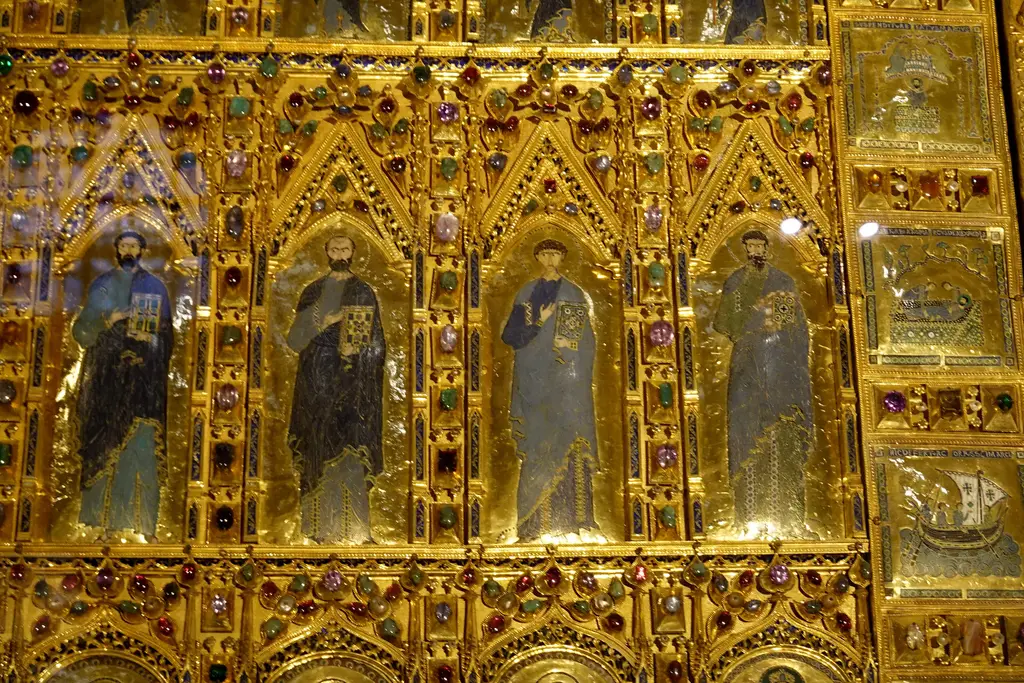
- The Pala d’Oro — the gold altarpiece behind the high altar, about 250 enamels and 1,927 precious stones, which the Basilica calls the only large work of Gothic goldsmithing in the world to survive intact.
- The Treasury — 283 pieces made over more than two thousand years, from rock-crystal lamps shaped as fish to the cups of Byzantine emperors and a caliph’s ewer.
- The Museum and the horses — the rooms over the narthex, the gilded bronze quadriga, and the terrace of the Loggia dei Cavalli.
- The façades — three fronts dressed in marble after 1204, the mosaic of the Last Judgement over the main door, the arches of months, virtues and Venetian trades.
- The sculpture — the iconostasis of the dalle Masegne, the carved columns of the ciborium, the Renaissance altars of Antonio Rizzo and Sansovino’s bronzes.
- The chapels and the Baptistery — the mosaics of Saint John the Baptist, of Sant’Isidoro and of the Madonna dei Mascoli.
Mosaic
Mosaic is the medium that makes St Mark’s. The Basilica’s chronology dates its beginning to the reign of Doge Domenico Selvo, 1071–1084, and it was still being added to four centuries later, when Florentine artists worked on it — Paolo Uccello is documented in 1425 — and when the Cappella dei Mascoli was decorated in the middle of the fifteenth century. The domes and the atrium are read scene by scene on the mosaics page, and the chapels on their own page.
Frequently asked questions
Why does St Mark’s look Byzantine?
Because Venice was. The Basilica’s own history says that in art, as in everything else, Venice was born Byzantine and stayed so for centuries: its trade, its politics and its artists looked east, to Constantinople, and craftsmen were called from there to make mosaics in the Byzantine manner.
How many columns does St Mark’s have?
More than 500, with as many capitals — most of them Byzantine, from the sixth to the eleventh century, and many brought from Constantinople.
Where are the original bronze horses?
In the Museum of St Mark’s. They stood on the façade until 1977, were moved indoors after restoration in 1982, and the ones on the loggia today are bronze copies.
Last checked: September 30, 2026