What to see inside St Mark’s
You have twenty minutes on a roped route, under gold mosaic, so it pays to know what to look for before you go in. This is what the Basilica documents, from the doors inward, and which of it needs more than the basic ticket.
Before you go in: the atrium
The narthex, or atrium, wraps round the west end of the church and is the first space you enter. Look down. In the marble floor are the names of Pope Alexander III and Emperor Frederick Barbarossa, with that of Doge Sebastiano Ziani, in memory of the Peace of Venice made in the Basilica in 1177 — the day the two highest powers in Europe met here.
Several Doges are buried in the atrium: the Basilica names Vitale Falier, who consecrated the church in 1094, the Dogaressa Felicita Michiel, Marino Morosini and Bartolomeo Gradenigo. The mosaics above tell the story that the façade only summarises.
The nave
Under the domes, the church is one gold-covered space; what the mosaics tell, dome by dome, is on the mosaics page. Three things to look for at eye level:
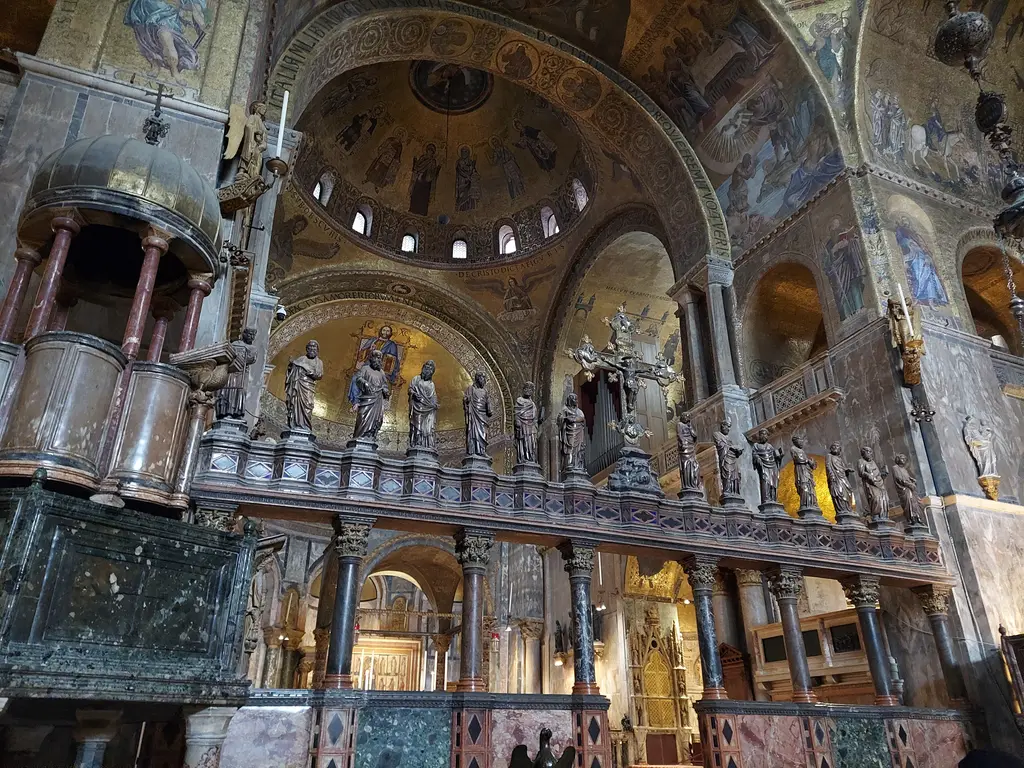
- The iconostasis, the marble screen across the nave with fourteen statues — the twelve Apostles, the Virgin and Saint Mark — signed by Pierpaolo and Jacobello dalle Masegne in 1394. Its brown surface is the smoke of centuries of candles. More on the sculpture.
- The pulpits. New Doges were presented and proclaimed from the right-hand pulpit, reserved for them, before going out into the Piazza.
- The columns. More than 500, with as many capitals, most Byzantine, many from Constantinople — matched in pairs by marble and grain.
The presbytery and the high altar
Behind the iconostasis is the most sacred place in the Basilica: the ciborium, in verde antico, over the high altar, where the marble sarcophagus holds the body of Saint Mark, moved from the crypt. Its four columns carry 108 carved scenes of the lives of the Virgin and of Christ. To the left and right of the high altar are the altars of the Nicopeia, the icon brought from Constantinople in 1204, and of the Blessed Sacrament, arranged in 1617.
The Nicopeia takes its name from the Greek for “bringer of victory”. The Basilica’s chronology lists it, with the four horses and the enamels of the Pala d’Oro, among the works brought to Venice after the conquest of Constantinople; the Basilica texts we read give no date for the painted panel itself, and the sources we found disagree on it, so we leave it open. A tradition, which visitors still repeat, attributes the painting to Saint Luke the Evangelist.
Behind the altar is the Pala d’Oro — this is the part that needs the Pala d’Oro ticket, and you have 10 minutes at most. See the Pala d’Oro.
The chapels
- The Mascoli chapel, founded by Doge Francesco Foscari in 1430, with Michele Giambono’s mosaics of the life of the Virgin.
- The chapel of Sant’Isidoro, finished in 1355, telling the saint’s martyrdom and the theft of his body from Chios.
- The Baptistery, with the Dance of Salome — visitable only with a guide.
All three are on the chapels page.
Upstairs: the Museum and the terrace
With the Museum ticket, stairs — or a lift and stair-lift — take you up to the rooms over the narthex: the original bronze horses, Paolo Veneziano’s painted cover for the Pala d’Oro, tapestries and carpets, and the door onto the Loggia dei Cavalli, the terrace above the Piazza. There is no time limit stated for the Museum, so this is where to slow down. See the Museum and the horses.
What the basic ticket does not open
The official price list sells the Basilica, the Pala d’Oro, the Museum and Loggia, and the Campanile. It does not list the Treasury, whose 283 pieces are described on its own page, or the crypt, which appears only in the guided evening visits. The route inside is roped, and the Basilica does not publish its exact course, so not every chapel may be within view on the day.
Five things not to miss
- The names of the Pope and the Emperor in the atrium floor.
- The dalle Masegne screen, and the brown of its marble.
- Saint Mark’s altar under the ciborium.
- The Pala d’Oro, if you bought the ticket.
- The horses, and the view from the terrace, if you bought the Museum.
Guided tours worth booking
Chosen for what they add over the plain ticket: a guide, the crypt, hours when the Basilica is closed. Most are run by tour companies, not by the Basilica.
Venice: St Mark's Basilica After-Hours Tour with Optional Doge's Palace
★ 4.7 · 1,577 reviews on Viator
Inside after closing time, with a guide, and down into the crypt; the Pala d’Oro is included.
- 75 min
- Non-refundable
from €129
See on Viator
Prices and ratings from Viator, checked on October 1, 2026. They change; the price on Viator is the one that counts. Affiliate links: if you book through them, Viator pays this site a commission, at no extra cost to you. It does not decide which tours appear here.
Frequently asked questions
Where is Saint Mark buried?
In the high altar, in a marble sarcophagus under the ciborium at the centre of the presbytery, moved there from the crypt.
Is the Treasury included in the ticket?
None of the tickets on the official price list names the Treasury. The tickets cover the Basilica, the Pala d’Oro, the Museum with the Loggia dei Cavalli, and the Campanile. Whether the Treasury is open, and sold on the spot, is not published: one recent visitor mentions paying a few euros extra for it, another found it closed in 2022.
Can I visit the crypt?
No ticket on the official price list includes the crypt; it appears only in the evening visits of the lit Basilica and crypt, sold with a guide.
Last checked: September 30, 2026