The Museum and the horses of St Mark’s
Independent guide — not the official website of St Mark’s Basilica. Official tickets: tickets.basilicasanmarco.it
Above the narthex, in rooms that include the Doge’s former Banqueting Hall, is the Museum of St Mark’s. Its greatest work is the Quadriga, the four gilded bronze horses that stood on the façade for more than five centuries; its door opens onto the Loggia dei Cavalli, the terrace over Piazza San Marco.
Key facts
- Highlight
- the four original gilded bronze horses, indoors since 1982
- Terrace
- the Loggia dei Cavalli, over Piazza San Marco
- Opened
- 16 May 1927
- Ticket
- Basilica and Museum, €20.00
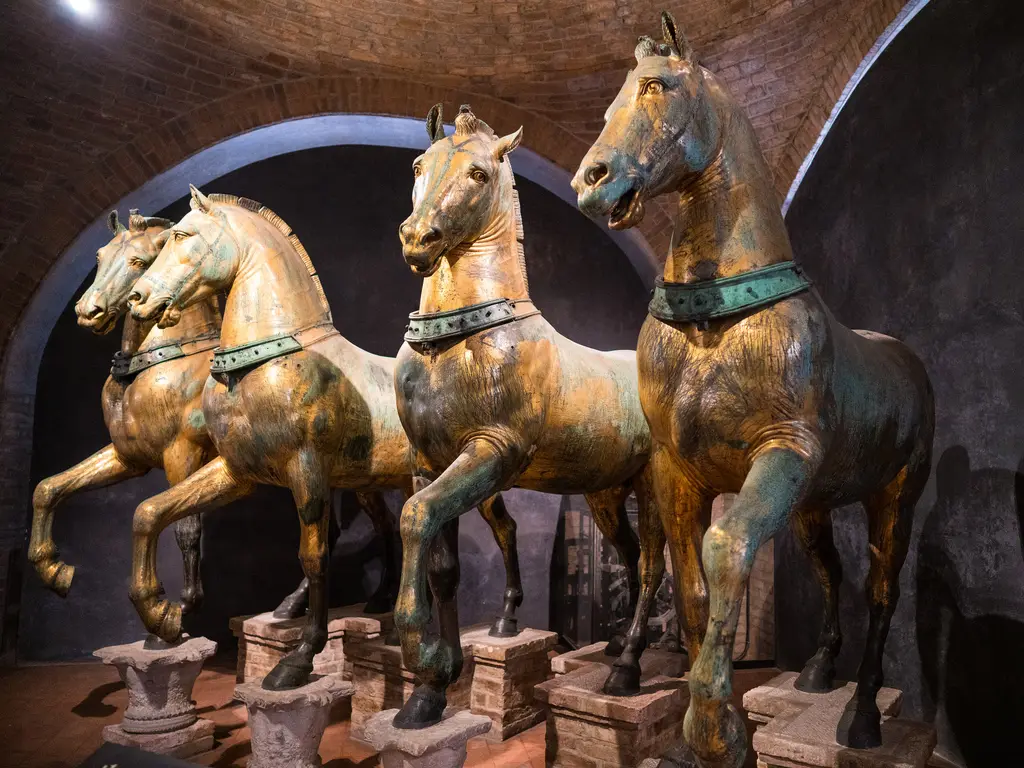
The Quadriga
The group is the only four-horse team in the round to survive from ancient sculpture. It was cast by the lost-wax method, the so-called indirect method, in an alloy of very high copper content — between 96.67% and 98.35% — suited to gilding with mercury. The scratches on its surface were perhaps made on purpose, to soften the glare of the sun.
Its date is still open. The Basilica sets out the whole argument rather than choosing: some scholars favour the Roman imperial age, between the later second and the early third century AD; earlier datings ran from the fourth century BC to the fourth century AD; and carbon-14 analysis points to the beginning of the second century BC.
Its journey. The horses are thought to come from the Hippodrome of Constantinople, sent to Venice by Doge Enrico Dandolo as spoils of the Fourth Crusade in 1204. They were probably raised onto the façade under Doge Ranieri Zeno (1253–1268), with a double meaning: political, as heirs to the imperial power of Byzantium, and religious, as the Quadriga Domini, the Word spread by the four Evangelists. The Sant’Alipio mosaic of about 1265 already shows them in place.
Petrarch was the first to wonder where they came from. The Renaissance gave them to Phidias, Praxiteles and Lysippus; Winckelmann, in the eighteenth century, raised the idea that they were Roman rather than Greek, and the debate has never closed.
In December 1797 they left the façade for the first time in more than five centuries, taken by Napoleon to Paris to crown the Arc du Carrousel. After his fall Antonio Canova was charged with bringing them back, and on 13 December 1815, before Francis I of Austria, they were returned to St Mark’s — damaged, and restored in the Arsenale first. Twice more, in the two world wars, they were taken down to shelter. Technical studies in the 1960s found them in poor condition; they left the loggia in 1977 and, after restoration, have been in the Museum since 1982, with bronze copies outside.
The Museum’s other works
- The Pala feriale of Paolo Veneziano, 1345, the painted panel that once covered the Pala d’Oro on ordinary days.
- Tapestries — fifteenth-century Flemish tapestries from the bequest of Cardinal Zen, four fifteenth-century tapestries of the Passion, and four sixteenth-century Medici tapestries of the Stories of Saint Mark.
- Persian carpets of the seventeenth century, ducal altar frontals, and seven illuminated graduals of the fifteenth and sixteenth centuries.
- Mosaic fragments removed in nineteenth-century restorations, shown in their old boxes, and a Madonna del latte painted between the thirteenth and fourteenth centuries.
- Sansovino’s gilded terracotta Madonna from the Loggetta of the bell tower, shattered in the collapse of 1902 and pieced back together.
What visitors report: the Museum’s galleries above the narthex bring you much closer to the mosaics than the floor of the church, and some say its lower-floor display, reached by stairs on the far side of the room with the horses, is easy to miss.
A museum that took a century
The idea came from Pietro Saccardo, fabbriciere from 1861 and proto of St Mark’s from 1887, who wanted to rescue “the precious tapestries, carpets, laces” then heaped in rough cupboards in the sacristy attics. His museum over the narthex was never formally opened. The collapse of the bell tower in 1902 and the First World War stopped the work, and it was Luigi Marangoni who opened the Museum to the public on 16 May 1927. Closed in June 1940, its works sent to safety at Carceri, it reopened on 13 April 1946; a new arrangement was inaugurated on 8 December 1961, and the present one — nearly a thousand square metres over the south, west and north sides of the narthex — on 8 October 2003.
The Loggia dei Cavalli
The Museum opens onto the terrace where the horses stood, with the copies beside you and Piazza San Marco below. The access rules ask that children up to 12 be held by the hand there, and that pushchairs be folded.
Guided tours worth booking
Chosen for what they add over the plain ticket: a guide, the crypt, hours when the Basilica is closed. Most are run by tour companies, not by the Basilica.
Legendary Venice Doge's Palace & St. Mark's with Exclusive Access
★ 4.7 · 6,049 reviews on Viator
Both landmarks in two hours; the three-hour options add the Basilica’s balcony over the Piazza.
- 2 h
- Non-refundable
from €71
See on Viator
Prices and ratings from Viator, checked on October 1, 2026. They change; the price on Viator is the one that counts. Affiliate links: if you book through them, Viator pays this site a commission, at no extra cost to you. It does not decide which tours appear here.
Frequently asked questions
Are the horses on the façade real?
No. The originals stood on the loggia until 1977; after restoration they were moved into the Museum in 1982, and bronze copies took their place outside.
How old are the horses of St Mark’s?
Nobody knows for certain. The Basilica notes that some scholars place them in the second half of the second or early third century AD, that earlier datings ranged from the fourth century BC to the fourth century AD, and that carbon-14 analysis points to the early second century BC.
Where did the horses come from?
They are thought to come from the Hippodrome of Constantinople, sent to Venice by Doge Enrico Dandolo as spoils of the Fourth Crusade.
How do I get into the Museum?
With the Basilica and Museum ticket (€20.00), or the full ticket. On Sunday mornings, when the church is closed for services, the Museum sells its own ticket at €14.00. There is a lift and a stair-lift.
Last checked: September 30, 2026