The history of St Mark’s Basilica
Three churches have stood here. The first was built for the body of Saint Mark, brought from Alexandria in 829; the present one was consecrated in 1094. This is the Basilica’s history as the Basilica itself records it, with its Italian beside every line.
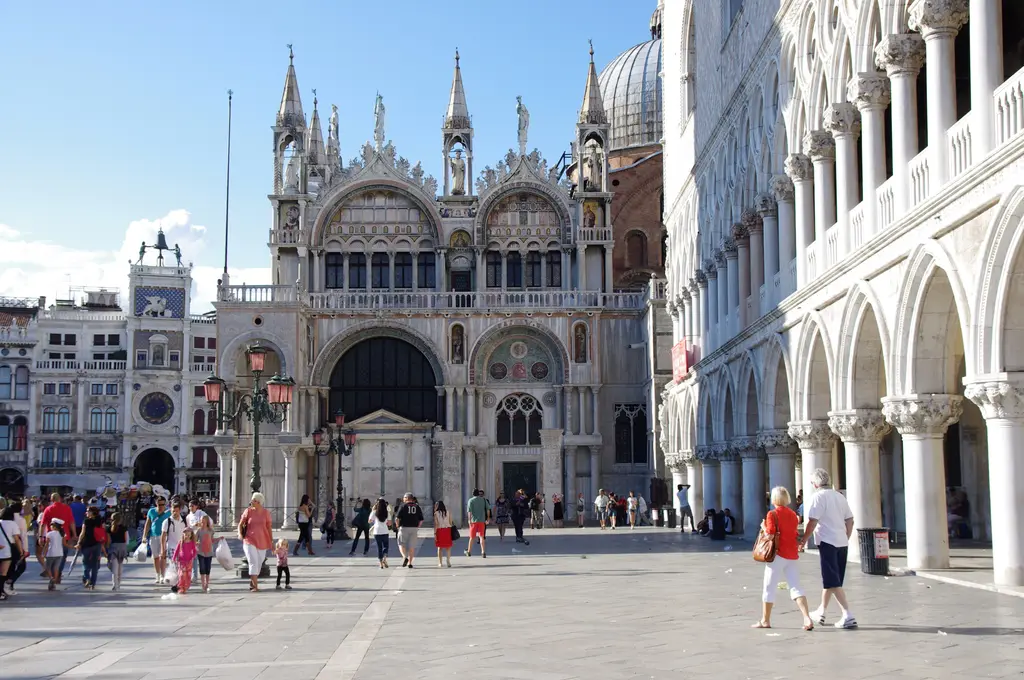
The Basilica year by year
829
The body of Saint Mark is brought from Alexandria in Egypt to Venice (Doge Giustiniano Partecipazio).
Original
Trasporto del corpo di San Marco da Alessandria d’Egitto a Venezia (Doge Giustiniano Partecipazio)
832
The first church of San Marco is consecrated (Doge Giovanni Partecipazio).
Original
Consacrazione della prima chiesa di San Marco (doge Giovanni Partecipazio)
976–978
The church burns in the revolt against Doge Candiano IV and is rebuilt under Doge Orseolo I, the Saint.
Original
Incendio della chiesa per la rivolta contro il doge Candiano IV e sua ricostruzione sotto il Doge Orseolo I il Santo
1063
Rebuilding of the present church begins (Doge Domenico Contarini).
Original
Inizio della ricostruzione dell’attuale chiesa (doge Domenico Contarini)
1071–1084
The mosaic decoration begins (Doge Domenico Selvo).
Original
Inizio della decorazione a mosaico (Doge Domenico Selvo)
1094
The church is consecrated (Doge Vitale Falier).
Original
Consacrazione della chiesa (Doge Vitale Falier)
1204
The Fourth Crusade: after the conquest of Constantinople, marbles and works of art are brought to the Basilica — the four horses, the icon of the Madonna Nicopeia, the enamels of the Pala d’Oro, and reliquaries, crosses, chalices and patens now in the Treasury (Doge Enrico Dandolo).
Original
Quarta Crociata e trasporto in basilica di marmi e di opere d’arte portate a Venezia a seguito della conquista di Costantinopoli (quattro cavalli, icona della Madonna Nicopeia, smalti della pala d’Oro, reliquiari, croci, calici, patene, oggi nel tesoro: Doge Enrico Dandolo)
1265
The Sant’Alipio mosaic records how the outside of the Basilica looked.
Original
Mosaico di Sant’Alipio con documentazione dell’esterno della basilica
1343–1354
The Baptistery and the Chapel of Sant’Isidoro are built (Doge Andrea Dandolo).
Original
Costruzione del Battistero e della Cappella di Sant’Isidoro (doge Andrea Dandolo)
1394
The iconostasis is built, with sculptures by Jacobello and Pier Paolo dalle Masegne.
Original
Costruzione dell’iconostasi e delle sculture che la decorano di Jacobello e Pier Paolo dalle Masegne
Late 14th – early 15th century
Gothic decoration of the façade: pinnacles, aedicules, and statues of angels and saints.
Original
Decorazione gotica della facciata con cuspidi, edicole, sculture di angeli e di santi
1419
Fire on the front part of the Basilica’s roof.
Original
Incendio sulla parte anteriore del tetto della basilica
First half of the 15th century
Tuscan artists work on the façade sculpture (Maestro Nicolò, Pietro Lamberti and perhaps Jacopo della Quercia), and Florentine artists on the mosaics — Paolo Uccello is documented in 1425.
Original
Intervento di artisti toscani (Maestro Nicolò e Pietro Lamberti e forse Jacopo della Quercia) nelle sculture della facciata: artisti fiorentini nei mosaici della basilica (Paolo Uccello è documentato nel 1425
Mid-15th century
Mosaic decoration of the Cappella dei Mascoli.
Original
Ornamento musivo della Cappella dei Mascoli
1486
The Sacristy is built beside the apse, followed by the rebuilding of the small church of San Teodoro by Giorgio Spavento, proto of the Basilica.
Original
Costruzione della Sacrestia a fianco dell’abside (a cui segue la ricostruzione della chiesetta di San Teodoro a opera di Giorgio Spavento, proto della basilica)
1496
Gentile Bellini records the outside of the Basilica in his Procession of the Relic in Piazza San Marco.
Original
Documentazione dell’esterno della basilica nel quadro di Gentile Bellini: Processione della reliquia in Piazza San Marco
1504–1521
The Zen Chapel is built in the right arm of the atrium, closing the solemn entrance portal towards the lagoon.
Original
Costruzione della Cappella Zen nel braccio destro dell’atrio, costruzione che ha otturato il solenne portale d’ingresso verso la laguna
1529
Sansovino consolidates the church’s walls and domes.
Original
Intervento del Sansovino per il consolidamento delle mura e delle cupole della chiesa
1617
The altar of the Nicopeia and the altar of the Blessed Sacrament are arranged, left and right of the high altar.
Original
Sistemazione dell’altare della Nicopeia e dell’altare del Santissimo Sacramento (a sinistra e a destra dell’altare maggiore)
1797
Fall of the Republic.
Original
Caduta della Repubblica
1807
The Basilica becomes the seat of the Patriarch of Venice, which until then had been San Pietro di Castello.
Original
La Basilica diviene sede del patriarca di Venezia, fino allora a San Pietro a Castello
The Doges and the Basilica
| Dates | Doge | In the Basilica’s history |
|---|---|---|
| 827–829 | Giustiniano Partecipazio (or Particiaco) | Receives the body of Saint Mark in Venice and decides to build the first church. |
| 829–836 | Giustiniano Partecipazio (or Particiaco) | Has the first San Marco built. |
| 959–976 | Pietro Candiano IV | Dies in a popular revolt; San Marco is destroyed by the fire set to the Doge’s Palace. |
| 1043–1071 | Domenico Contarini | Has the third great San Marco designed on the model of the Apostoleion. |
| 1071–1084 | Domenico Selvo | Is crowned Doge in a San Marco “nondum perfecta” — not yet finished. The first mosaics date from his reign. |
| 1084–1096 | Vitale Falier | Consecrates the church (1094) and lays the body of Saint Mark to rest in the crypt for good. Buried in the atrium. |
| † 1101 | Felicita Michiel | Buried in the atrium. |
| 1102–1118 | Ordelaffo Falier | Orders the first Pala d’Oro from Byzantium. |
| 1192–1205 | Enrico Dandolo | The Doge of the Fourth Crusade and the conquest of Constantinople. |
| 1205–1229 | Pietro Ziani | Assembles the new Pala d’Oro with its upper section, spoils of Constantinople. |
| 1249–1253 | Marino Morosini | Buried in the atrium. |
| 1312–1329 | Giovanni Soranzo | Buried in the Baptistery. |
| 1339–1343 | Bartolomeo Gradenigo | Buried in the atrium. |
| 1343–1354 | Andrea Dandolo | Builds the Baptistery and the Chapel of Sant’Isidoro, and gives the Pala d’Oro enamels their new and final arrangement. Buried in the Baptistery. |
| 1423–1457 | Francesco Foscari | Builds the new chapel of the Madonna, or dei Mascoli. |
| 1462–1471 | Cristoforo Moro | Adds the Renaissance altars of San Clemente, San Paolo and San Giacomo. |
| 1486–1501 | Agostino Barbarigo | Under his reign Giorgio Spavento builds the new sacristy and the small church of San Teodoro. |
| 1523–1539 | Andrea Gritti | Commissions Jacopo Sansovino’s rebuilding of the presbytery. |
| 1631–1646 | Francesco Erizzo | His heart is buried in an urn under the floor of the presbytery. |
Cronologia essenziale · I Dogi e la Basilica
Last checked: September 30, 2026
The photographs on this page and the rest of the site are credited in the gallery.
Three churches
The first church of San Marco was built to house a relic. In 829 the body of Saint Mark the Evangelist was brought to Venice from Alexandria, under Doge Giustiniano Partecipazio, who decided to build a church for it. (The Basilica’s page on Saint Mark dates the arrival to 31 January 828; its chronology gives 829.) The Basilica’s own pages describe the first church in two ways, and we give both: its chronology has it consecrated in 832 under Doge Giovanni Partecipazio, while its page on the Doges credits Giustiniano Partecipazio with having it built, and dates that to 829–836.
That church burned in 976, in the revolt that killed Doge Pietro Candiano IV, when the fire set to the Doge’s Palace spread to it. It was rebuilt under Doge Orseolo I, called the Saint.
The church you visit is the third. Doge Domenico Contarini had it designed on the model of the Apostoleion, Constantinople’s Church of the Holy Apostles, and rebuilding began in 1063. His successor, Domenico Selvo, was crowned in a church still nondum perfecta, not yet finished, and the first mosaics date from his reign. Doge Vitale Falier consecrated it in 1094 and laid Saint Mark’s body in the crypt.
The Republic’s chapel
For as long as the Republic lasted, St Mark’s belonged to the Doge, not to a bishop. For about a thousand years it served as the Doges’ chapel. Domenico Selvo was crowned in it, several Doges are buried in its atrium and Baptistery, and one after another they added to it: the Pala d’Oro ordered from Byzantium by Ordelaffo Falier, enlarged by Pietro Ziani with spoils of Constantinople and given its final arrangement by Andrea Dandolo; the Mascoli chapel of Francesco Foscari; Sansovino’s presbytery for Andrea Gritti.
The Republic fell in 1797. Ten years later, in 1807, the Basilica became the seat of the Patriarch of Venice, moving the cathedral from San Pietro di Castello.
Church of State
The Doge did not only own the church; he ran it. He appointed its head, the Primicerio, who was given the authority of a bishop, and the church was entrusted to the Procurators of Saint Mark. Every newly elected Doge was presented to the people and proclaimed inside the Basilica, from the right-hand pulpit reserved for him, before going out into the Piazza.
It was the stage for the Republic’s great moments. Soldiers were blessed there before leaving for war, and flags taken from the enemy were presented there. In 1177 the Basilica saw the Peace of Venice between Pope Alexander III and Emperor Frederick Barbarossa, the highest authorities of Europe, with Doge Sebastiano Ziani; their names are carved in the marble floor of the atrium. In 1201 Doge Enrico Dandolo gathered the crusaders there before they sailed. In 1377, with the Genoese pressing on the city, the people carried Vettor Pisani into St Mark’s so that the Doge would give him command of the defence. And during the plagues the Senate made its vows there: in 1576 to build the Redentore, in 1630 to build the Salute.
Merchants and sailors, too, brought it precious gifts from their voyages, to keep great and rich the monument that stood for the greatness of Venice.
Byzantium, and the Fourth Crusade
In art, as in everything else, the Basilica says, Venice was born Byzantine and stayed so for centuries. Between the ninth and the fourteenth century its trade and its politics faced east, towards Constantinople, and it called artists from there to make works and mosaics in the Byzantine manner. From the twelfth century the Arab and Muslim world became a second source of forms.
The Fourth Crusade is sometimes called the crusade of the Venetians. Launched by Pope Innocent III against the Sultan of Egypt, it was turned by Venice into a campaign of its own. Venice had not forgotten 1171, when Emperor Manuel had ten thousand Venetians arrested and killed in Constantinople. The crusaders gathered in Venice in 1202; in April 1203, despite the Pope’s excommunications, they took Constantinople to restore the young Alexios, who was killed in an uprising; in 1204 they took it again for themselves. On the proposal of the old Doge Enrico Dandolo the empire was divided among the victors and a Latin Empire founded, of which Venice received “a quarter and a half”. The spoils — gold, marble, works of art, the four horses — are still in the Basilica, its Treasury and its Museum.
After the Republic
On 12 May 1797 the Serenissima fell to Napoleon’s troops. The Treasury was plundered to pay the French, the horses were taken to Paris, and in 1807, by Napoleon’s wish, the cathedral was moved from San Pietro di Castello to St Mark’s, which ceased to be the Doge’s chapel and became the city’s cathedral.
The Bishop of Venice holds the title of Patriarch, because the see is held to be of apostolic foundation: by very ancient tradition Saint Mark, disciple and interpreter of Peter, evangelised the Veneto before Venice existed. In the twentieth century three Patriarchs of Venice were elected Pope: Giuseppe Sarto, Pius X; Angelo Giuseppe Roncalli, John XXIII; and Albino Luciani, John Paul I.
Frequently asked questions
What was the Peace of Venice?
The meeting in the Basilica in 1177 between Pope Alexander III and Emperor Frederick Barbarossa, with Doge Sebastiano Ziani. Their names are carved in the marble floor of the atrium.
Which Patriarchs of Venice became Pope?
Three in the twentieth century: Giuseppe Sarto (Pius X), Angelo Giuseppe Roncalli (John XXIII) and Albino Luciani (John Paul I).
How old is St Mark’s Basilica?
The present church was consecrated in 1094, after rebuilding began in 1063. A church of San Marco has stood on the site since the first was consecrated in 832.
Where did the four horses come from?
From Constantinople. The Basilica’s chronology lists them, with the icon of the Madonna Nicopeia and the enamels of the Pala d’Oro, among the works brought to Venice after the conquest of the city in the Fourth Crusade, 1204.
Who designed the present church?
The Basilica names the Doge rather than an architect: Domenico Contarini had it designed on the model of the Apostoleion, the Church of the Holy Apostles in Constantinople.
Why is the lagoon doorway closed?
The Zen Chapel, built between 1504 and 1521 in the right arm of the atrium, blocked what had been the solemn entrance from the lagoon.
Last checked: September 30, 2026