The mosaics of St Mark’s
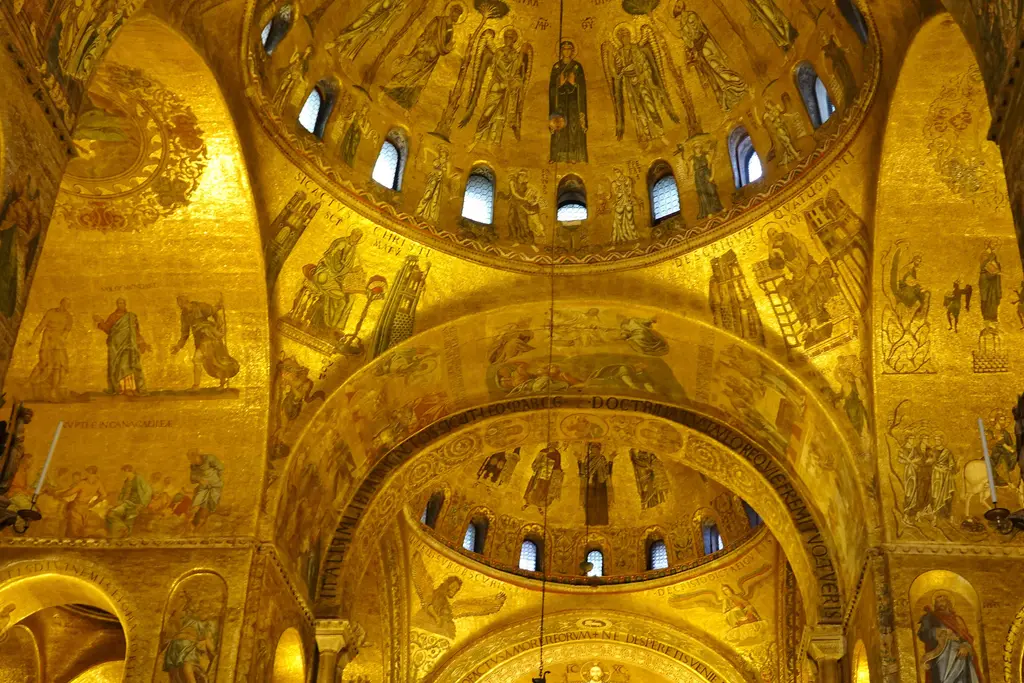
The gold mosaics of St Mark’s are meant to be read like an illuminated Gospel, from the door to the altar. The atrium tells the Old Testament, the time of waiting; inside, three great domes tell the coming of Christ, his Ascension and the descent of the Spirit. This guide follows them in that order, in the words of the Basilica’s own descriptions.
Key facts
- Begun
- under Doge Domenico Selvo, 1071–1084
- The three great domes
- Pentecost, Ascension, Prophets, from the door to the altar
- Apse
- Christ Pantocrator, a remake of 1506
- Workshop
- the Basilica’s own mosaic workshop since 1881
How to read them
The Basilica faces east, with its main door to the west, and the mosaics follow the path of the sun along that axis. The atrium (narthex) shows the time of waiting: the Old Testament, from the Creation to Moses. Crossing the main door is, in the Basilica’s words, a symbolic entry into the Promised Land. Inside, the story of salvation runs from the prophecies of the Messiah, over the altar, to the Last Judgement, over the entrance, and its three focal points are the three great domes of the nave.
The visit route is roped and short — 20 minutes at most inside the Basilica, along the roped route (Pala d’Oro not included) — so it helps to know where to look. The rest of the interior is on what to see inside.
The atrium: the Old Testament
The story begins in the south-west corner, on your right as you enter the atrium.
- The Creation cupola. Twenty-six scenes in three rings around a centre of golden scales, under the Latin text of Genesis. God the creator is shown, in the Eastern manner, as the young Christ with a cross. Each day an angel joins the work; the rare scene of the blessing of the seventh day shows God enthroned among the six angels, blessing a seventh. Below: Eve drawn from Adam’s rib, the serpent, the Fall and the expulsion from Eden.
- Cain and Abel, Noah and the Tower of Babel continue on the arches and lunettes near the Porta di San Clemente and beyond the main portal.
- The Abraham cupola, near the Porta di San Pietro: God speaking to Abraham is a hand reaching out of a segment of sky, four times over.
- Three cupolas of Joseph, on the north side: the dreamer sold by his brothers who becomes their saviour in Egypt.
- The Moses cupola, the masterpiece of the last generation of thirteenth-century Venetian mosaicists, where the figures no longer stand alone on gold but move through landscapes and architecture.
Around the main door, in niches, are the Virgin and Child among eight apostles and the four evangelists: among the oldest mosaics in the church, perhaps from the last years of the eleventh century, attributed to Greek mosaicists.
Over the door
Inside, look back up at the lunette over the main door. It is a Deësis, the prayer of intercession: Christ between the Virgin and — in place of John the Baptist, as Eastern icons would have it — Saint Mark. Christ’s open book reads Ego sum ostium, “I am the door”: the real door to salvation, the Basilica explains, is Christ himself.
The dome of the Prophets
The story starts over the high altar. In the dome, Christ appears as a young, beardless Emmanuel among the stars; below stand the Virgin and thirteen prophets — Isaiah, Jeremiah, Daniel, Obadiah, Habakkuk, Hosea, Jonah, Zephaniah, Haggai, Zechariah, Malachi, Solomon and David — each with a scroll. Isaiah points to the child: “Behold, a virgin shall conceive.” David wears the robes of a Byzantine emperor. On the pendentives are the symbols of the evangelists: Mark’s lion, Luke’s ox, Matthew’s angel, John’s eagle. The great Christ Pantocrator in the apse is a Renaissance remake of 1506, replacing a Byzantine image.
The arch over the iconostasis carries the feasts of the Epiphany — the Annunciation, the Magi, the Presentation, the Baptism, the Transfiguration — remade at the end of the sixteenth century on cartoons by Tintoretto.
The dome of the Ascension
At the crossing is the dome the Basilica calls the masterpiece of its mosaics, from the second half of the twelfth century. Christ, seated on a rainbow, is carried up by four angels; below, the Virgin between two angels and the twelve apostles look up, separated by little trees that stand for the Mount of Olives. Between the windows dance sixteen women, the Virtues and Beatitudes, led by Charity, crowned, “mother of all virtues”. The Ascension itself has a Byzantine precedent in Hagia Sophia at Thessaloniki; the sixteen Virtues, the Basilica notes, are purely Venetian.
On the pendentives the evangelists write the first words of their Gospels, above the four rivers of Paradise pouring water on the faithful. The Greek master of this dome has been called the master of the “agitated style”. His colours are the most precious in the church — glass paste made with lapis lazuli, copper, gold, silver and iron — and the faces of Christ, the Virgin and the angels are lit with white highlights, as if light came from within.
The dome of Pentecost
Over the nave, nearest the door, the Holy Spirit descends. From a dove on a throne, twelve rays of silver light spread across the gold and end as red flames on the heads of the twelve apostles. Between the sixteen windows stand the peoples to whom the apostles carried the Gospel, and on the pendentives are four angels the Basilica calls of unequalled beauty. It is the work of another master, active at St Mark’s in the 1130s and 1140s.
The three domes form one design, finished in three or four decades by three principal masters and a skilled team: the Father awaited by the prophets over the altar, the Son rising at the centre, the Spirit pouring out over the nave.
The vaults: miracles and Passion
- The transepts and the north vault of the central dome show Christ’s miracles; many of these scenes were remade in the sixteenth and seventeenth centuries.
- The south vault of the central dome — the Temptation, the Entry into Jerusalem, the Last Supper and the Washing of the Feet — is among the best preserved mosaics of the first half of the twelfth century.
- The west vault shows the Passion: Judas’s betrayal, the Crucifixion, the women at the tomb, the Descent into Hell and Thomas’s doubt.
- The Agony in the Garden, on the right wall of the nave, is a thirteenth-century addition and one of the masterpieces of the whole cycle, in which three hands can be recognised.
- The Apocalypse and the Last Judgement, over the entrance, close the story. They were among the parts most rebuilt, in restorations that ran from the early nineteenth century to the 1930s.
Who made them
In the twelfth century the mosaicists were Greek. In the thirteenth, masters from Constantinople worked alongside others trained in Venice — and after the conquest of Constantinople in 1204, the Basilica writes, Venice had to make the Doge’s chapel worthy of its new role as master of “a quarter and a half” of the Empire. The chapels have their own cycles of the fourteenth and fifteenth centuries: see the Baptistery and the chapels.
Nine centuries of restoration
The mosaics have been restored since the end of the 1200s, and earthquakes, the shifting of the building and the air remain, the Basilica says, the greatest threats to them.
- Until the end of the thirteenth century, restorers respected the original design.
- In the sixteenth and seventeenth centuries, damaged scenes were often replaced outright, with mosaicists translating cartoons by the great painters of the day: Titian, Tintoretto, Veronese, Palma il Giovane, the Salviati and others.
- In the eighteenth century the old mosaics were valued again; Leopoldo Dal Pozzo made the lunettes and vault of the Porta di San Pietro on cartoons by Sebastiano Ricci.
- In the nineteenth century, with the building in poor condition, large surfaces were taken down and replaced, keeping the old designs. The replacements ended late in the century under the proto Pietro Saccardo, answering the protests of John Ruskin and Alvise Zorzi, and in 1881 he founded the Basilica’s mosaic workshop.
- In the twentieth century Manfredo Manfredi and Luigi Marangoni refined the technique as far as restoring “from behind”: taking down the wall instead of the mosaic, consolidating the mosaic in place, and rebuilding the wall.
Today, the Basilica explains, restorers find loose areas by tapping with their knuckles and listening, or with a stethoscope and a tuning fork, and fix them with a fluid mortar of lime, fine marble dust and a little acrylic resin. Where salt has destroyed the bedding, the mosaic must be lifted, cleaned and reset.
The inscriptions
Almost every scene carries a Latin inscription: Bible verses, medieval prayers written for the Basilica — often addressed to Saint Mark — and the name of each saint, as on an icon. Greek appears only in a few places, such as the monograms of Christ and the Virgin. For the Basilica this is the point: open to Byzantium, Venice still belonged to the Latin West.
Frequently asked questions
Which is the most important mosaic dome in St Mark’s?
The Basilica calls the central dome of the Ascension, from the second half of the twelfth century, the masterpiece of its mosaics and the heart of its spiritual message — the best in structure, quality and state of preservation.
How old are the mosaics?
The oldest, around the main door from the atrium, may date from the last years of the eleventh century. The great domes are twelfth-century, the atrium cupolas thirteenth-century, and many scenes were remade between the sixteenth and nineteenth centuries.
Who made the mosaics?
In the twelfth century, Greek masters from the Byzantine world; in the thirteenth, masters from Constantinople working with others trained in Venice. Later, mosaicists translated cartoons by painters such as Titian, Tintoretto and Veronese.
Are the mosaic inscriptions in Latin or Greek?
Almost all are in Latin. The few in Greek include the monograms of Christ and the Virgin and some saints’ names — a sign, the Basilica says, that Venice, open as it was to Byzantium, belonged to the Western world.
Last checked: October 1, 2026