The Baptistery and the chapels
Three spaces off the main church carry some of the finest mosaics in St Mark’s. Two were made for Doge Andrea Dandolo in the fourteenth century, the Baptistery and the chapel of Sant’Isidoro; the third, the chapel of the Madonna dei Mascoli, was founded by Doge Francesco Foscari in 1430.
The Baptistery
Once called the Giesia dei putti, the children’s church, the Baptistery lies on the south side of the Basilica, formerly open to the Piazzetta. It has three parts: the ante-baptistery, where catechumens waited, the baptistery proper, and the presbytery. Its present form is the work of Andrea Dandolo, Procurator and then Doge from 1343 to 1354, a man of great learning and a friend of Petrarch.
Excavations in 1978 found the remains of an old immersion font with its water channels, confirming the room’s early use. Frescoes have surfaced twice: in 1889, and in 1963, when an Ascension was uncovered to the left of the altar, where it can still be seen.
The altar is a huge block of red granite brought from Tyre by Doge Michiel in 1125 as a relic: it was said that Jesus had preached the Beatitudes from it. The font was designed by Jacopo Sansovino, proto of St Mark’s from 1527 to 1570, whose remains rest at the foot of the altar; its bronze lid, with scenes of John the Baptist and the Evangelists, was made in 1545 by Tiziano Minio and Desiderio da Firenze, and Francesco Segala’s bronze Baptist crowned it in 1566.
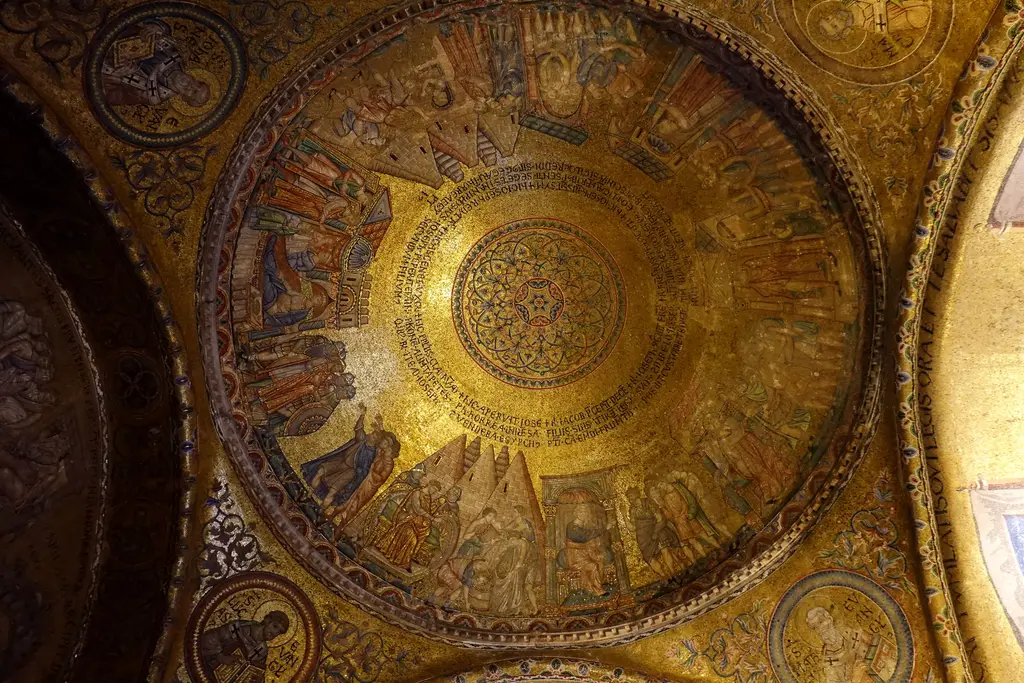
The mosaics tell the life of John the Baptist, from his birth to his beheading, culminating in the Dance of Salome in the north lunette. In the ante-baptistery his story runs alongside Christ’s childhood and meets it in the Baptism in the Jordan. Over the altar, the Crucifixion shows the Virgin, Saint Mark, Saint John the Evangelist, and Andrea Dandolo with his counsellor. In the domes: Christ sending the Apostles to preach and baptise, and Christ in glory among the nine choirs of angels. The tombs of Doges Giovanni Soranzo and Andrea Dandolo stand against the marble walls.
The chapel of Sant’Isidoro
Venice’s devotion to Saint Isidore of Chios begins on 16 April 1125, when his body, stolen by the cleric Cerbano Cerbani, was brought from Chios under Doge Domenico Michiel — and then hidden, and not spoken of until the fourteenth century. Andrea Dandolo had this chapel built in a small courtyard off the north transept; an inscription under Christ in the lunette over the altar dates its completion to 10 July 1355, and the saint was laid in his tomb on 1 May 1356.
The barrel vault tells his story: his life and martyrdom on the south side, the finding of his body, its theft and its arrival in Venice on the north. Over the altar lies the sarcophagus with the saint’s effigy, watched by an angel with a censer and an unusually large incense boat — a reference to Chios and its mastic, burnt as incense in a Venice just recovered from the plague of 1348. Recent studies, the Basilica notes, link the decoration of the arch over the tomb to iconography from as far as China.
The chapel of the Madonna dei Mascoli
Founded in 1430 by Doge Francesco Foscari and the Procurators Leonardo Mocenigo and Bartolomeo Donato, perhaps in thanks for the failed attempt on the Doge’s life on 11 March 1430, it was first called the “new chapel of the Madonna”. It took the name of the Mascoli — the Confraternity of the Purification — in 1618.
Its vault holds a mosaic cycle of the life of the Virgin, begun by the Venetian Michele Giambono in the first half of the fifteenth century: her Birth, the Presentation, the Annunciation, the Visitation and the Dormition. The Basilica reads in it the passage from late Gothic grace to the Renaissance: in the Dormition, all but the right-hand group of apostles is in the manner of Andrea del Castagno, down to the red Thessalian marble of the great classical arch behind them.
Frequently asked questions
Can I see the Baptistery?
The official visitor ticket covers the Basilica, the Pala d’Oro and the Museum; the tariff sells the Basilica and Baptistery ticket only with a guide, for groups of up to 25, for 30 minutes.
Who is buried in the Baptistery?
Doge Giovanni Soranzo, Doge Andrea Dandolo, and Jacopo Sansovino, whose remains lie at the foot of the altar.
Why is it called the Mascoli chapel?
From 1618, when Doge Antonio Priuli allowed the Confraternity of the Purification, known as the Mascoli, to hold its services at its altar.
Last checked: September 30, 2026