The façades of St Mark’s
St Mark’s was meant to stay bare brick. It was only after the conquest of Constantinople in 1204, when marble, columns, capitals and reliefs arrived by the shipload, that the Venetians dressed three of its sides in stone. Each façade was given a different job, and decorated for it.
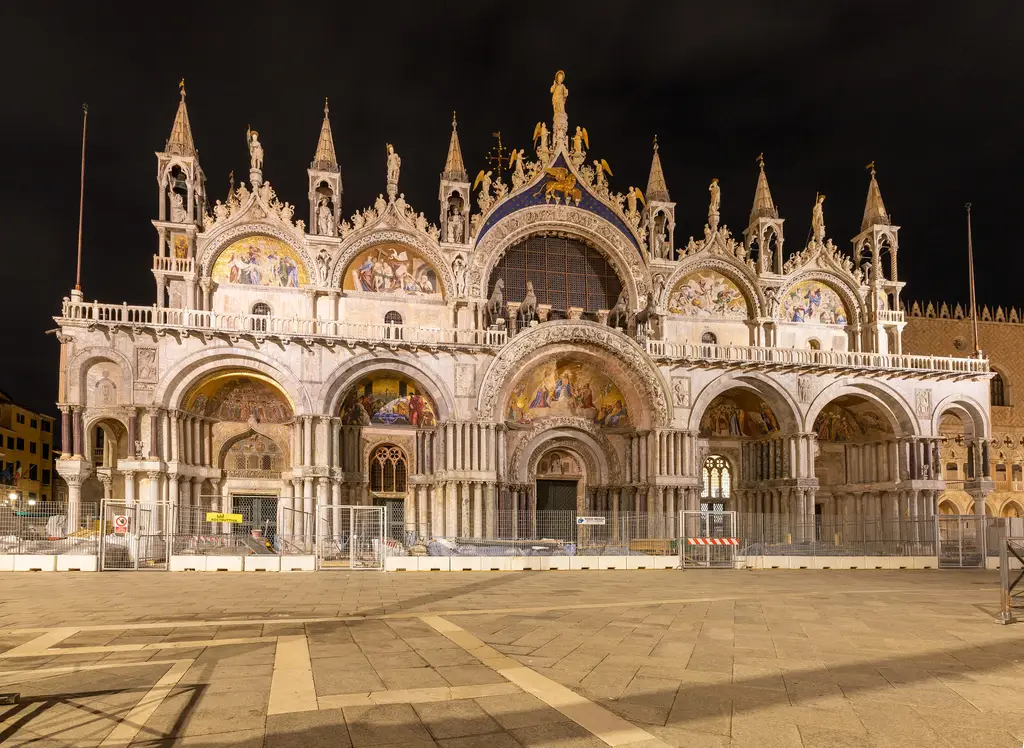
The outside, from the top
The skyline is made by the raised domes, wooden structures covered in overlapping lead sheets, built in the thirteenth century over the brick domes below. Round the top of every façade runs the Gothic crown of aedicules, statues and foliage, made in the fourteenth and fifteenth centuries by Niccolò and Pietro Lamberti and other Tuscan artists.
There are three façades, north, west and south; the east end, with the apse, was absorbed into the Doge’s Palace.
The west front, on the Piazza
This is the façade with a message. The Basilica describes it as the title page of the text that the mosaics inside set out at length: it claims, it asks for protection, it insists on possessing Saint Mark’s relics, it speaks of triumph and wealth, and it urges virtue and civic order. At its centre is the Last Judgement, softened by lunettes of the Passion, Death and Resurrection; the story of Saint Mark’s relics and the mysteries of Christ’s life are also told in mosaic.
The terrace with the copies of the horses divides it into two storeys of five great arches. Below, from the left: the Porta di Sant’Alipio, the Porta di San Pietro, the main portal, the Porta di San Clemente, and the window of the Zen Chapel.
Set into the thirteenth-century marble are Byzantine reliefs read in pairs across the main portal: the warrior saints George and Demetrius; the Angel Gabriel and the Virgin, an Annunciation that recalls Venice’s legendary foundation on 25 March 421; and, at the far ends, the Labours of Hercules, a pagan hero turned into an allegory of salvation.
The main portal
Three stepped arches, carved on both faces, made within about a decade around the middle of the thirteenth century by several hands.
- The first arch shows two crouching figures, Satan and Lust, from whom springs a vine full of animals, fights, fables and Samson with the lion — the evil that rules the world, and the dark wood of human life.
- The second arch carries the twelve months with the signs of the Zodiac, and seventeen Virtues and Beatitudes. The months are more Byzantine than Western: March is a warrior in arms, April a shepherd with a lamb on his shoulders. The Basilica notes the cycle matches no other.
- The third arch frames the Last Judgement with the trades of Venice, in place of the liberal arts of the French cathedrals — the most Venetian part of all the façades, and in the Basilica’s words more an expression of civic pride than an allegory.
The outer arch of Prophets, dated roughly 1250–1275, is the latest and most mature sculpture of the west front, its twisting vines already reaching towards the flowering Gothic.
The south front, to the sea
This side was built to dazzle anyone arriving by water: the richly carved pillars called “of Acre” but in fact from Constantinople, the porphyry Tetrarchs on the corner, and the Pietra del Bando, on which, the old chronicles say, the heads of traitors to the Republic were displayed for three days and three nights.
It also changed the most. Here was the porta da mar, the great sea door that led from the quay straight into the atrium, in the days when water still surrounded the Doge’s Palace. No image of it survives. It was closed in the early sixteenth century when the south atrium became the funerary chapel of Cardinal Giovanni Battista Zen.
The north front, on the Piazzetta dei Leoncini
More private than the others. Beside the Porta dei Fiori are thirteenth-century reliefs of Christ and the four Evangelists; over the door a Nativity, framed by angels and prophets. The great niche at the end of the transept holds the tomb of Daniele Manin (1875), and the relief of Saint Christopher on the buttress belongs to the original design.
The Gothic crown in detail
Above each ogee arch stands a saint venerated in Venice or a Virtue; at the centre of the main front, against a starry sky, is a Lion of Saint Mark — a nineteenth-century cast-iron copy of the original destroyed in 1797 — under a statue of the Evangelist with six gilt-winged angels. The aedicule on the north-west corner is dated 1384, the start of the work. Most of the carving followed two documented deliveries of marble from Lucca, in 1414 and 1419, which also name the artists probably in charge: Paolo and Jacobello dalle Masegne, then Niccolò di Pietro Lamberti of Florence. Four saints that fell in the earthquake of 1511 were replaced by Giorgio Albanese in 1618.
Frequently asked questions
Why are the domes so tall from outside?
They are wooden structures covered in lead sheets, raised in the thirteenth century over the lower brick domes.
What is the mosaic over the main door?
The Last Judgement, the central image of the west front, flanked by lunettes of the Passion, Death and Resurrection of Christ.
What are the Tetrarchs?
A porphyry group set into the corner of the south façade, one of the trophies meant to impress anyone arriving by sea.
Why is the Annunciation on the façade?
It alludes to Venice’s legendary foundation on 25 March 421, the feast of the Annunciation.
Last checked: September 30, 2026