The sculpture of St Mark’s
Inside St Mark’s the sculpture ranges from sixth-century Byzantine columns to the bronzes of Jacopo Sansovino. These are the works the Basilica singles out: the iconostasis, the columns of the ciborium over Saint Mark’s tomb, the columns and capitals, the fifteenth-century altars and Sansovino’s choir.
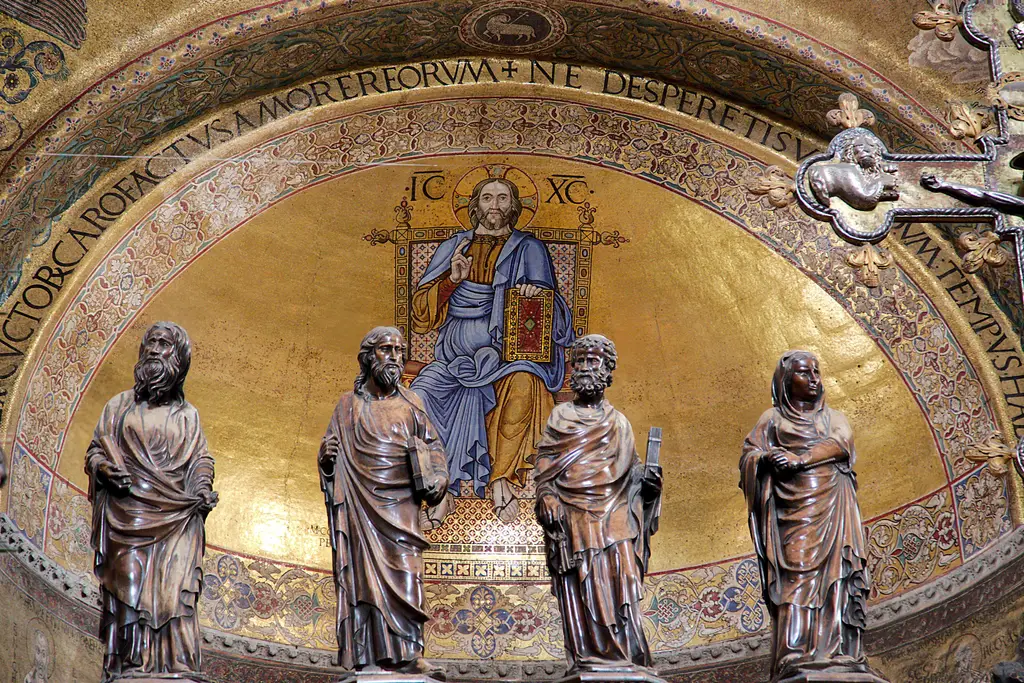
The iconostasis, 1394
Across the nave, closing off the presbytery, stands the screen of the Venetian brothers Pierpaolo and Jacobello dalle Masegne: fourteen marble statues of the twelve Apostles with the Virgin and Saint Mark, made towards the end of the fourteenth century. Its central part carries the date 1394 and both signatures; it is the only work of the dalle Masegne with an undoubted signature to survive complete. It replaced a thirteenth-century screen whose low arches are still in place.
The Basilica points out that it is not strictly an iconostasis, since it holds no icons — a “screen of columns” would be more exact. The marble has gone brown, probably from the smoke of candles placed between the figures, but traces of the original colours survive on the hems. Its programme recalls the screen of Old St Peter’s in Rome, a sign that Venice meant to rival the Apostle’s church. Two smaller Gothic screens, with female saints, close the chapels of San Pietro and San Clemente. The mosaic chapels are described on their own page.
The ciborium over Saint Mark
At the centre of the presbytery is the most sacred place in the Basilica: the ciborium of verde antico over the high altar, where the marble sarcophagus with the body of Saint Mark lies, moved from the crypt. It was raised in the first half of the thirteenth century, probably in the 1220s.
Its four columns are carved with scenes from the canonical and apocryphal Gospels. Each monolithic shaft, of Docimian and Pentelic marble, is divided into nine bands of nine little arches — 324 niches holding 108 scenes: the life of the Virgin after the Greek Protevangelium of James, the youth and miracles of Jesus, his teaching after Luke, and his Passion. In the Crucifixion the figure of Christ is replaced by the mystic Lamb. Their date and origin are still argued over; comparing them with Byzantine ivories and sixth-century sculpture in Istanbul, the Basilica places them under Emperor Anastasius I (491–518). The Latin inscriptions were added in Venice in the thirteenth century.
On Saint Mark’s feast, the sarcophagus is freed from its grilles and covered with red roses, and the Pala d’Oro is turned to face the faithful.
Five hundred columns
St Mark’s has more than 500 columns and as many capitals. A few are classical, of the third century; most are Byzantine, from the sixth to the eleventh century, largely spoils from Constantinople and medieval copies. They were placed with rigorous symmetry, matched by marble and by the grain of the stone.
The finest are in the apses. Four capitals on columns of Thessalian green are of the same type as the main capitals of Hagia Sophia in Constantinople. Only two of the eight were genuine eleventh-century Constantinopolitan pieces; the other six are medieval copies, made so that all three apses would match — perhaps because no more could be found. In the west narthex, black-and-white breccia columns that carry nothing were added in the thirteenth century purely for effect, their parts possibly from the imperial palace of Constantinople.
The Renaissance altars
In the transepts, beside the pulpits, stand the altars of Saint Paul and Saint James, and a third is in the chapel of San Clemente. All three were commissioned by Doge Cristoforo Moro (1462–1471), whose name each bears, and made by the young Antonio Rizzo of Verona, paid for them on 28 June 1469 — his debut, with the most prestigious sculptural commission then available in Venice.
Sansovino’s bronzes
On 7 April 1529 the Procurators appointed Jacopo Sansovino proto of St Mark’s. Besides consolidating the walls and domes and remaking the Piazza, he turned the medieval choir into a Renaissance one, divided between the Doge’s choir and the raised choir of the clergy. For the two singers’ galleries he made signed bronze reliefs of the miracles of Saint Mark (1537, and 1541–1546), whose crowded drama would influence Tintoretto.
His masterpiece, all scholars agree, is the bronze door of the sacristy, modelled from 1546: the Entombment and the Resurrection, framed by Prophets and Evangelists, with six heads in the corners. Three are identified, thanks to his son Francesco: Jacopo himself, Titian and Pietro Aretino.
Frequently asked questions
What does the sacristy door show?
The Entombment and the Resurrection, framed by Prophets and Evangelists. Three of the six heads in the corners are identified: Sansovino himself, Titian and Pietro Aretino.
Who made the iconostasis?
The Venetian brothers Pierpaolo and Jacobello dalle Masegne, who signed and dated it 1394. It is the only work with their undoubted signature to survive complete.
How old are the ciborium columns?
Their dating is still debated, but the Basilica, comparing them with Byzantine ivories and sixth-century sculpture in Istanbul, places them in the reign of Emperor Anastasius I (491–518).
Last checked: September 30, 2026