St Mark’s Campanile
Independent guide — not the official website of St Mark’s Basilica. Official tickets: tickets.basilicasanmarco.it
The bell tower of St Mark’s is 98.6 metres high, crowned by a statue of the Archangel Gabriel. The Venetians called it el paron de casa, the master of the house. It stood for almost a thousand years, fell on 14 July 1902, and was rebuilt “as it was, where it was”.
Key facts
- Height
- 98.6 m, with the Archangel Gabriel on top
- Collapse
- 14 July 1902, rebuilt “as it was, where it was”
- Ticket
- €15.00, separate from the Basilica
- Summer hours
- 9:30 – 21:15, last admission between 20:00 and 20:30
- Winter hours
- 9:30 – 19:15, last admission between 18:00 and 18:45
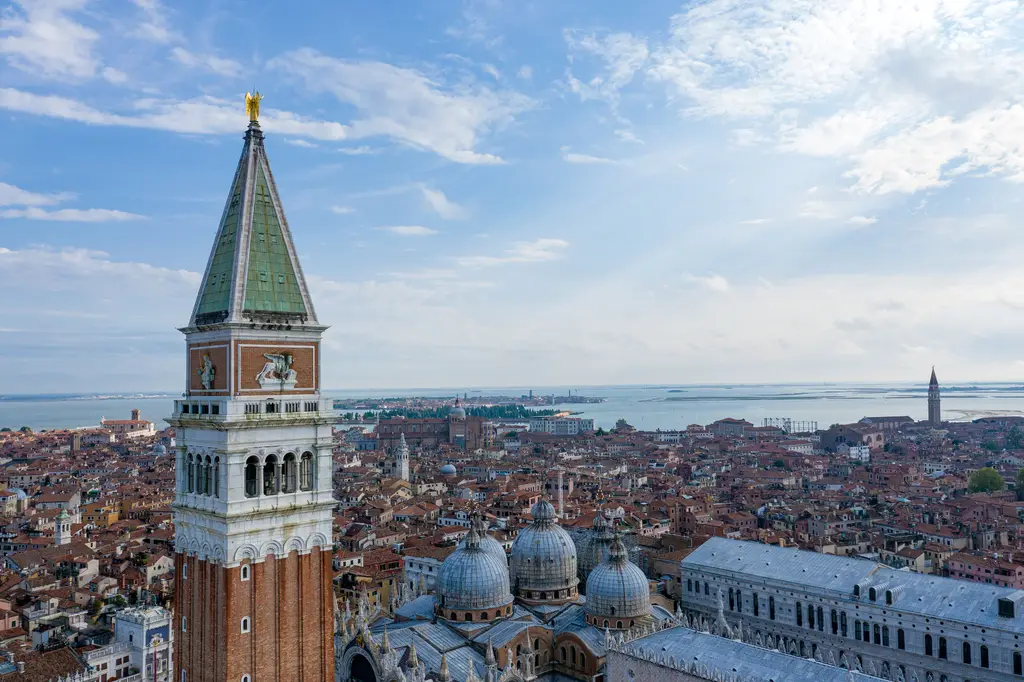
Visiting
The Campanile has its own ticket, €15.00, and does not need a Basilica ticket. Summer hours are 9:30 – 21:15, last admission between 20:00 and 20:30; winter, 9:30 – 19:15, last admission between 18:00 and 18:45. Times may vary with events, the month of the year and bad weather. A lift takes you to the belfry in 30 seconds.
The Basilica or the Campanile?
They are two different visits, on two tickets, and they answer different wishes.
| Compared | Basilica | Campanile |
|---|---|---|
| Ticket | €10.00 and up | €15.00 |
| What you get | the church, its mosaics, the Pala d’Oro and the Museum as extras | the lift to the belfry and the view from the top |
| Time | 20 minutes at most inside the Basilica, along the roped route (Pala d’Oro not included) in the church | no stated limit |
| Hours | 9:30 – 17:15, last admission 16:45 Monday to Saturday | 9:30 – 21:15, last admission between 20:00 and 20:30 in summer |
| Residents free? | yes | no |
If you can do only one, the Basilica is the reason people come to the Piazza; the Campanile is the view of everything around it.
Both in one day
The hours make it easy. See the Basilica in a morning or early-afternoon slot, and climb the Campanile at the end of the day, when it is open for hours after the church has closed. They face each other across the Piazza. The Basilica’s best slots are on the best time to visit page.
A thousand years in one tower
The story begins in 888, when Doge Pietro Tribuno ordered a watchtower to defend the political heart of the city. Probably not fit for the purpose, it was pulled down in 910 and replaced by a larger tower that was both a lighthouse for sailors and the city’s bell tower. Its foundations — piles 26 centimetres thick and 1.5 metres long, a double deck of oak, and a stone base 12 metres square and 5 high — would carry it for almost a thousand years.
Building was slow: the walls rose from 939–942, reached the belfry by 979–991, and were raised to 60 metres under Doge Domenico Morosini in 1148–1156. Under Vitale Michiel II (1156–1172) Niccolò Barattieri and Bartolomeo Malfatti built the belfry, crowned with a wooden spire covered in gilded copper.
A lightning rod before its time
A copper point on a tall, isolated tower drew lightning for centuries before Benjamin Franklin could explain why. The chronicles record strike after strike: 7 June 1388; a fire lit by celebration lamps on 24 October 1403; a bolt that tore off the spire in 1489; the earthquake of 26 March 1511, after which the bells were silenced. Pietro Bon rebuilt the belfry and spire, and on 6 July 1513 the gilded wooden Angel was set on top, turning with the wind.
More strikes followed — in 1582, and in 1745, when falling masonry hit four passers-by and their little dog — and the tower was propped and reinforced by the best engineers of the day. At last, on 18 May 1776, the Abbot Giuseppe Toaldo of the University of Padua fitted a lightning conductor, to the city’s wonder, and the strikes did no more harm.
14 July 1902
Neglected under foreign rule, the tower’s decay became plain when the last shops around its base were demolished in 1874. From 1885 Giacomo Boni warned repeatedly that the foundations would have served a tower only two-thirds as tall. Through years of opinions, inspections and work begun and abandoned, it moved towards its end, and on 14 July 1902 it collapsed in on itself, alone in a square closed to the public, killing no one.
It was rebuilt com’era e dov’era, as it was and where it was, and inaugurated on 25 April 1912, the feast of Saint Mark.
The bells
Venice’s day was run by them. The largest, the Marangona, named after the Arsenale’s shipwrights, marked midnight and the start and end of every shift. The Trottiera called the Great Council: nobles hurried to the Doge’s Palace at a trot, and when it stopped the doors were shut. The Nona rang noon and the last post from Rialto, the Mezza terza called the Senate, and the smallest, the Maleficio, rang for half an hour for a death sentence.
In 1902 only one bell survived, the Marangona, found unharmed on top of the rubble. Pope Pius X, who had been Patriarch of Venice, paid for the four others to be recast; they sound the chord of A — A, B, C♯, D and E.
The Loggetta
At the foot of the tower stands Jacopo Sansovino’s Loggetta, built between 1537 and 1549 as a meeting place for nobles and later a guard post for the Arsenale workers during the Great Council. Its niches hold his bronzes of Minerva, Apollo, Mercury and Peace. Buried and shattered in 1902, it was pieced back together and finished with the Campanile in 1912; Sansovino’s terracotta Madonna from inside it is now in the Museum.
Frequently asked questions
How tall is St Mark’s Campanile?
98.6 metres. The square brick shaft is 12 metres a side and 53.75 metres high; the belfry and spire sit on top of it.
Is there a lift?
Yes, since 1932. It reaches the belfry in 30 seconds.
How much is a ticket?
€15.00, bought separately from the Basilica. Residents’ free entry does not apply to the Campanile.
When did the Campanile collapse?
On 14 July 1902. It fell in on itself in an empty, cordoned-off square, and no one was killed.
Did Galileo climb it?
The Basilica records that the Campanile hosted Galileo Galilei from 21 to 24 August 1609, when he presented his telescope to the Doge.
Last checked: September 30, 2026