The Pala d’Oro
Independent guide — not the official website of St Mark’s Basilica. Official tickets: tickets.basilicasanmarco.it
Behind the high altar of St Mark’s stands the Pala d’Oro, 3.34 metres wide and 2.12 metres high, made of about 250 cloisonné enamels on gilded silver and set with 1,927 precious stones. The Basilica calls it the only large work of Gothic goldsmithing in the world to have survived intact.
Key facts
- Size
- 3.34 m wide, 2.12 m high
- Made of
- about 250 cloisonné enamels on gilded silver, 1,927 precious stones
- Dates
- begun 1102–1118, renewed 1209, present form 1343–1345
- Where
- behind the high altar
- Ticket
- Basilica and Pala d’Oro, €20.00
- Time allowed
- 10 minutes at most
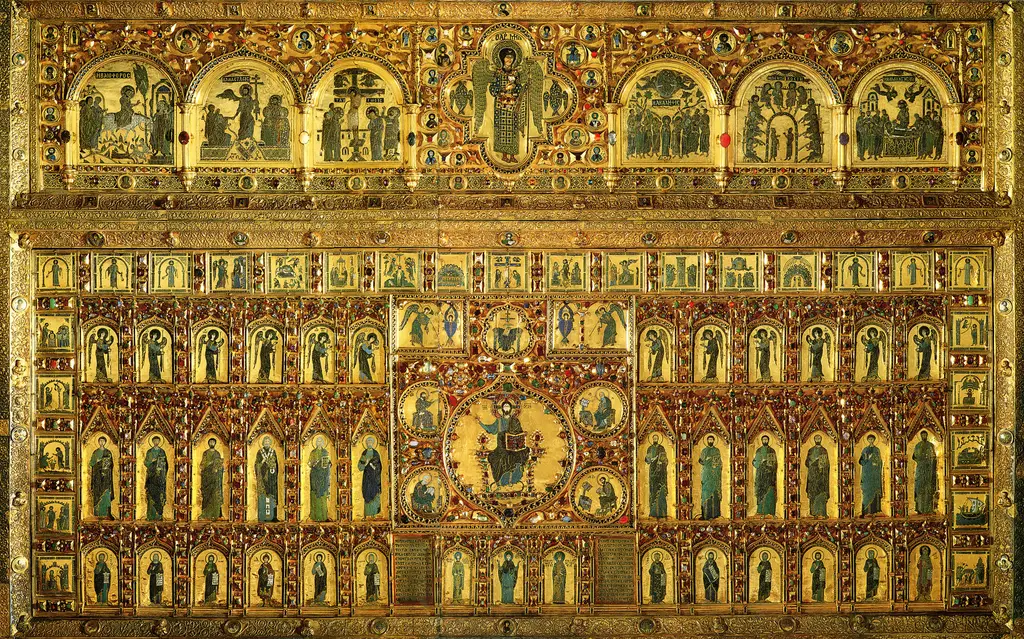
What it shows
The lower part is dominated by Christ blessing, surrounded by the four Evangelists. On either side, in three rows, stand twelve prophets, twelve apostles and twelve archangels, and below them the Virgin praying, Doge Ordelaffo Falier and the Empress Irene. Above Christ is the Etimasia, the throne prepared for the Last Judgement, with two cherubim and two archangels. Along the top run almost all the feasts of the Byzantine Church, from the Annunciation to Pentecost, and down the sides, in ten small panels, the life of Saint Mark on the left and, on the right, his martyrdom in Alexandria and the journey of his body to Venice.
The upper part is a great frieze with the Archangel Michael at its centre and six scenes: the Entry into Jerusalem, the Descent into Limbo, the Crucifixion, the Ascension, Pentecost and the Death of the Virgin. It came from one of the three churches of the monastery of the Pantocrator in Constantinople.
Four phases
- Ordelaffo Falier (1102–1118). The Doge ordered the first Pala from Byzantium, and the enamels of the lower part — the stories of Saint Mark, the six deacons, the feasts of Christ and the central Pantocrator — were arranged in his time.
- Pietro Ziani, 1209. An inscription beside the Virgin says the Pala renovata fuit in 1209. The upper enamels were probably brought from Constantinople after 1204; a Patriarch of Constantinople visiting St Mark’s in 1438 said, sadly, that they came from the Pantocrator church.
- Andrea Dandolo, 1343–1345. The Pala was entirely renewed and took the form it has today. A second inscription credits the Procurators Marco Loredan and Francesco Querini with the precious stones, and the craftsmen signed the back: Giovanni Paolo Bonesegna for the goldwork in 1342, and Master Perin for the carpentry in 1345. Some enamels were trimmed at the edges and others moved.
- Lorenzo and Pietro Fauro, 1836–1847. The last restoration ended on 13 May 1847 by fixing the upper part to the lower for good.
A Pala that used to close
Until 1847 the upper part was hinged. A system of pulleys, worked from two columns behind it crowned by the Angel and the Virgin of the Annunciation, could fold it down over the lower part like a book. Closed, it was covered by a painted panel, the pala feriale, for ordinary days. The oldest, by Paolo Veneziano and his sons in 1343–1345, is now in the Museum, and the two columns with their Annunciation are in the Treasury.
The Pala was opened only for great celebrations, in the presence of the Doge and of leading figures of international politics.
Seeing it today
It stands behind the high altar, normally turned to the side away from the nave, where visitors can see it at close quarters. Entry is by the Basilica and Pala d’Oro ticket, €20.00, and the access rules allow 10 minutes at most. Every ticket is compared on the tickets page, and the rest of the interior on what to see inside.
Guided tours worth booking
Chosen for what they add over the plain ticket: a guide, the crypt, hours when the Basilica is closed. Most are run by tour companies, not by the Basilica.
Venice: St Mark's Basilica After-Hours Tour with Optional Doge's Palace
★ 4.7 · 1,577 reviews on Viator
Inside after closing time, with a guide, and down into the crypt; the Pala d’Oro is included.
- 75 min
- Non-refundable
from €129
See on Viator
Prices and ratings from Viator, checked on October 1, 2026. They change; the price on Viator is the one that counts. Affiliate links: if you book through them, Viator pays this site a commission, at no extra cost to you. It does not decide which tours appear here.
Frequently asked questions
How big is the Pala d’Oro?
3.34 metres wide and 2.12 metres high, in two parts, with about 250 enamels and 1,927 precious stones and gems.
How old is the Pala d’Oro?
Its lower part dates from Doge Ordelaffo Falier (1102–1118). It was renewed in 1209 under Pietro Ziani, and took its present form in 1343–1345 under Andrea Dandolo.
Do I need a separate ticket?
Yes. The Basilica and Pala d’Oro ticket is €20.00, or the Pala d’Oro can be added to a Basilica ticket for €10.00. You have 10 minutes at most in front of it.
Why does it face away from the nave?
Since 1958. Patriarch Angelo Roncalli did not like tourists leaning on the high altar to see it, so a mechanism was made to lift and turn it. It faces the nave only in ceremonies celebrated by the Patriarch.
Last checked: September 30, 2026